Articles
The Football Field Funnel: Why the B2B Buying Journey is Not Linear

Quick Answer: The traditional B2B marketing funnel assumes a linear, clean handoff from marketing to sales. In reality, modern B2B purchasing resembles a drunk football play, full of stalled momentum, lost yards, and new stakeholders. By replacing the funnel with a "football field" framework, companies align sales and marketing to move the ball together. At Blue Triangle, tracking accounts across this field revealed prospects engaged 50 to 60 times before requesting a demo.
Here is the most common conversation I have with SaaS CEOs: marketing is reporting wins on their lead dashboard, sales is frustrated because the pipeline isn't growing, and both teams are telling the truth.
The root of the problem is the model itself.
The traditional marketing funnel assumes a clean handoff. Marketing generates leads, qualifies them, passes them to sales, and sales closes the deal. That linear assumption is completely disconnected from how B2B buying actually works today.
The Drunk Football Play
A modern B2B deal involves six to ten people at the buying company. They research for months before anyone fills out a form. They evaluate competitors, read your content, and talk to peers long before your sales team even knows they exist. By the time someone finally requests a demo, they have already made 80% of their decision.
The buying journey looks less like a funnel and more like a drunk football play.
You make forward progress, but then security raises a red flag and you get pushed back to the 30-yard line. Your champion leaves the company, the deal goes dark, and three months later a new contact picks it up so you have to rebuild momentum. Then they need to bring finance in before moving forward.
Meanwhile, your seller is going up against a full defense. They face entrenched solutions, competitors who have been on the prospect's radar for months, and budget freezes. They also fight inertia, which wins more deals than any actual competitor.
Most companies send one sales rep out there against all of that and wonder why deals stall.
The Football Field Framework
The companies that win treat selling like a team sport. They use a football field framework.
The prospect is the football. A touchdown is closing the sale. The goal of the entire go-to-market team is to keep moving the ball toward the end zone, even when they lose yards or have to call a timeout.
Everybody is on the field, moving the ball together. Marketing builds awareness for months so the prospect has heard of you before the first call. SDRs run targeted outbound plays to qualify interest, while partners bring existing relationships to bypass the defense. Customer Success even comes in during the evaluation to show what happens after the deal closes.
It takes four quarters to win the game. Sometimes it takes overtime.
How To Measure The Football Field
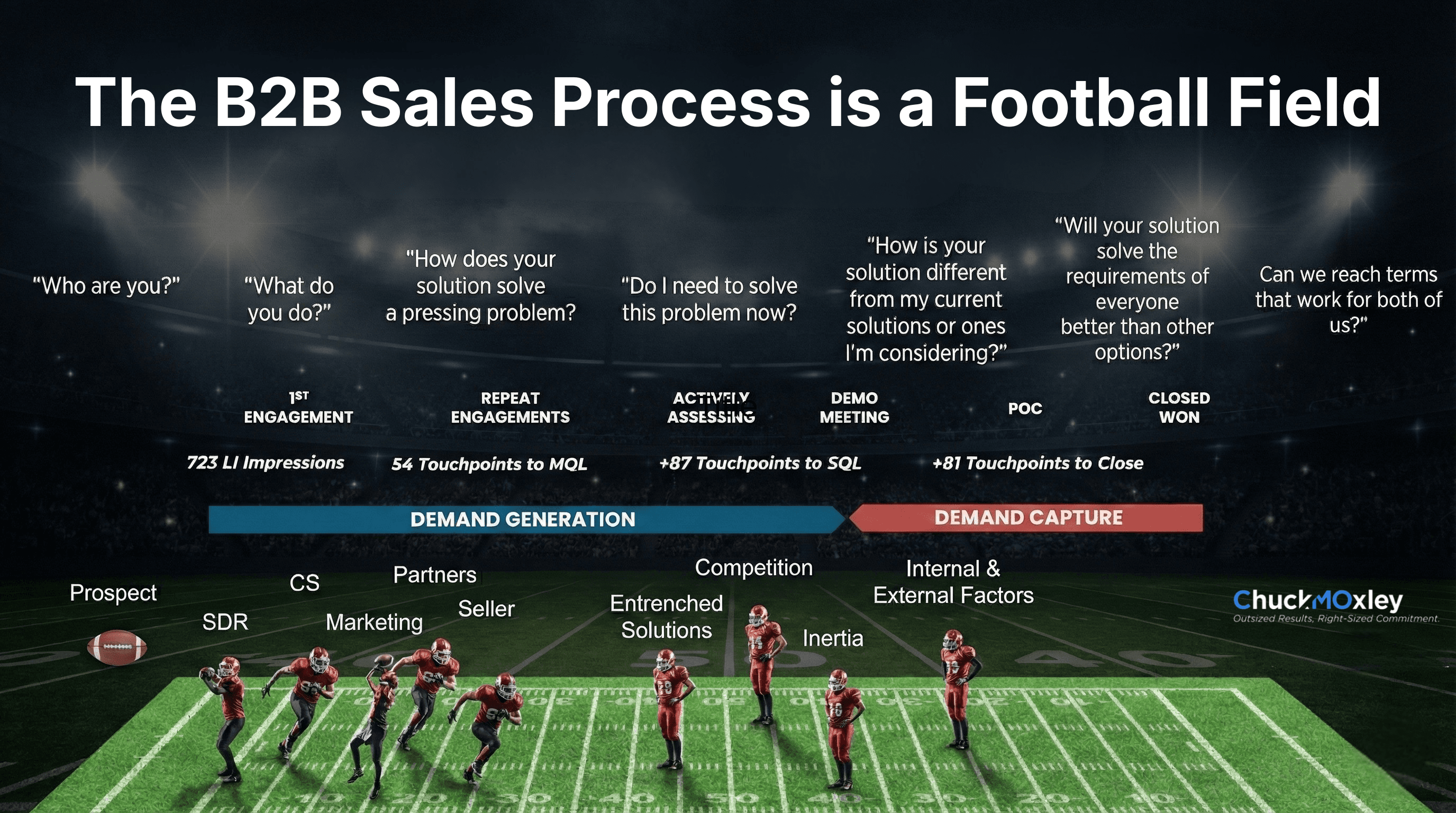
If you abandon the funnel, you have to track engagement by account, measuring progress down the field rather than counting individual leads.
When we implemented this at Blue Triangle, we defined six specific stages:
First Engagement: A target company visits the site.
Repeat Engagement: They come back multiple times, indicating an active buying committee.
Active Assessment: They hit high-intent pages like pricing, demos, or case studies.
Demo Request: They ask to speak with sales (the red zone).
Proof of Concept: Active evaluation.
Closed Won: Touchdown.
We tracked 478 target companies through this model. 72% hit stage one, and 81% of those came back for repeat engagement. 27% moved to active assessment.
The most shocking metric? The average prospect touched our content 50 to 60 times before requesting a demo.
Questions People Ask About The Football Field Model
How do you track an account before they fill out a form?
You use intent data platforms like 6sense or Clearbit. These tools identify which companies are visiting your website and reading your content, allowing you to track their progress down the field anonymously.
Does this mean marketing is responsible for closing deals?
Marketing is responsible for revenue, just like sales. The football field model aligns both teams around the exact same goal: moving the account to closed-won. Marketing provides air cover throughout the entire process.
How do you explain this to a board that wants to see MQLs?
You show them the pipeline. Boards care about revenue. When you present a dashboard showing target accounts moving through active assessment and into the red zone, the board will stop asking about MQLs.
What happens when a deal stalls?
You run a different play. If a deal stalls in the red zone, marketing might launch a targeted ad campaign specifically for the buying committee, or the CEO might reach out to their executive sponsor. You never leave the sales rep alone on the field.
What To Do Next
Pull up your CRM and look at your last five closed-won deals. Map out every touchpoint those accounts had with your company before they signed the contract.
You won't see a straight line. You will see a messy, complicated journey across a football field.
Once you accept reality, you can stop fighting it. Align your sales and marketing teams to play the game together.
About Chuck Moxley
Chuck Moxley is a Fractional CMO for B2B and SaaS companies. With over 20 years of experience leading marketing at seven SaaS companies, he helps CEOs fix marketing when it isn't driving pipeline. Connect with Chuck on LinkedIn: https://www.linkedin.com/in/chuckmoxley/
Learn more: https://www.chuckmoxley.com